Massive nationwide revolt in France over inflation and school issues: Cars set ablaze in Paris and Marseille City Hall attacked, 5 lakh protesters hit streets
Movement started by student unrest turns into major political crisis against Macron government: Trade unions and Yellow Vest supporters join protests, public buildings vandalized
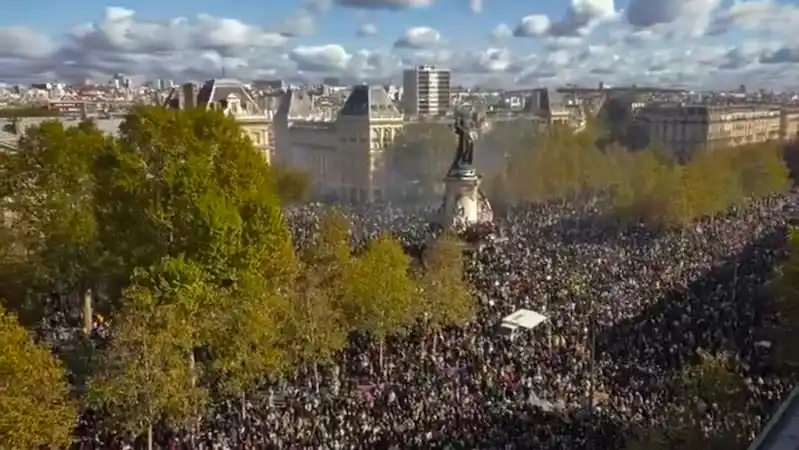
France/Paris: The European nation of France has once again been gripped by widespread social and political turmoil. An agitation initially sparked by students over dilapidated conditions in state-run schools, acute teacher shortages, and a lack of basic facilities has escalated into a massive nationwide public uprising. Alongside high school and university students, working-class groups, major trade unions, and supporters of the well-known Yellow Vest movement have joined the demonstrations in large numbers.
Violence erupts in Paris and Marseille on 17 October:
On 17 October 2026, conditions turned volatile during rallies held across major French cities, including the capital city of Paris. Agitated protesters set multiple cars and vehicles on fire along key Parisian streets and intersections. In the southern French city of Marseille, protesters stormed the local City Hall municipal headquarters, forcing their way into the lobby and vandalizing the premises. In addition, public buildings, government properties, and commercial shops were targeted in cities such as Lyon, Rennes, and Toulouse. Trash bins were set on fire in multiple locations, and projectiles were hurled at police checkpoints.
Police crackdown and over 272 arrests:
To disperse violent clashes, French police and anti-riot units fired extensive volleys of tear gas shells and deployed water cannons across Paris and other sensitive zones. According to preliminary official figures released by the interior ministry, at least 272 suspected protesters have been detained across the country so far. Police officials stated that masked agitators threw firecrackers and stones at public institutions, compelling security personnel to resort to baton charges in several places.
More than 5 lakh protesters take to the streets:
Estimates released by major French trade unions, notably the CGT, indicate that more than 5 lakh (500,000) demonstrators participated in this nationwide mobilization. Union leaders declared that the unrest is no longer restricted to educational issues alone. Sharp increases in daily food prices, fuel rates, and utility bills, coupled with demands for wage hikes and deteriorating standards in public services such as hospitals and schools, have exhausted public patience.
Major political and economic test for Macron administration:
These widespread protests pose a severe challenge to the government of President Emmanuel Macron. What began as a demand for school infrastructure upgrades has broadened into an organized political movement challenging the administration's economic blueprint. Critics allege that state cutbacks to public services budgets have severely strained ordinary household finances.
President Macron appealed for calm, noting that while peaceful protest is a constitutional right in a democracy, arson and property destruction will not be tolerated under any circumstances. Despite this warning, trade unions and student federations cautioned that demonstrations will escalate further unless the government introduces concrete steps to raise salaries and invest in public infrastructure.



Comments